What Is a Data Structure?
A data structure is a way of organizing, storing, and managing data efficiently so it can be accessed and modified effectively.
In programming, data structures help:
- Store large amounts of data
- Improve performance
- Optimize memory usage
- Enable faster searching and sorting
- Build scalable applications
Because efficient data handling is critical in software development, understanding data structures is a fundamental skill for every programmer.
Types of Data Structures
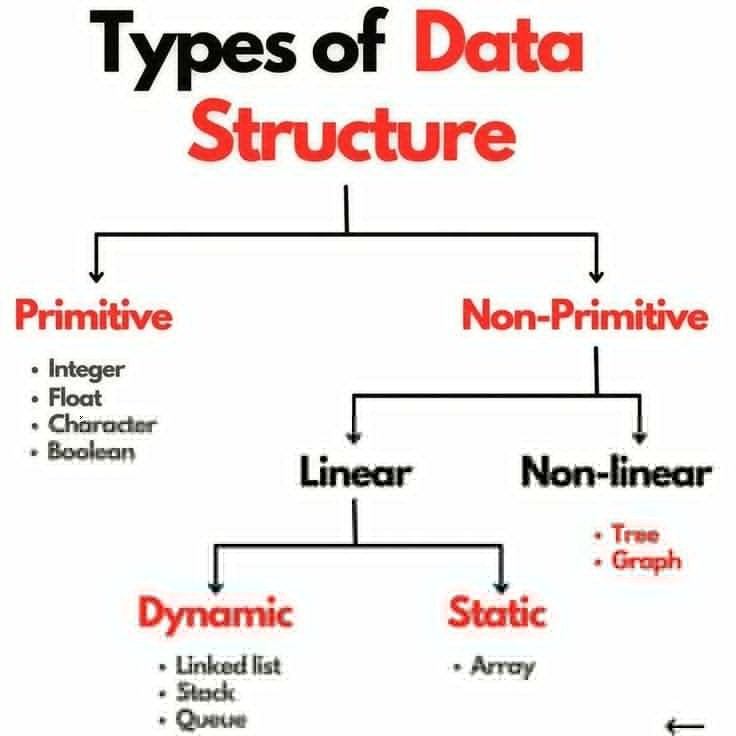
Data structures are mainly divided into two categories:
- Primitive Data Structures
- Non-Primitive Data Structures
Let’s explore them in detail.
Primitive Data Structures
Primitive data structures are basic data types provided by programming languages.
Examples include:
- Integer
- Float
- Character
- Boolean
These types store single values and serve as the building blocks for more complex data structures.
Non-Primitive Data Structures
Non-primitive data structures are more complex and can store multiple values.
They are further divided into:
- Linear Data Structures
- Non-Linear Data Structures
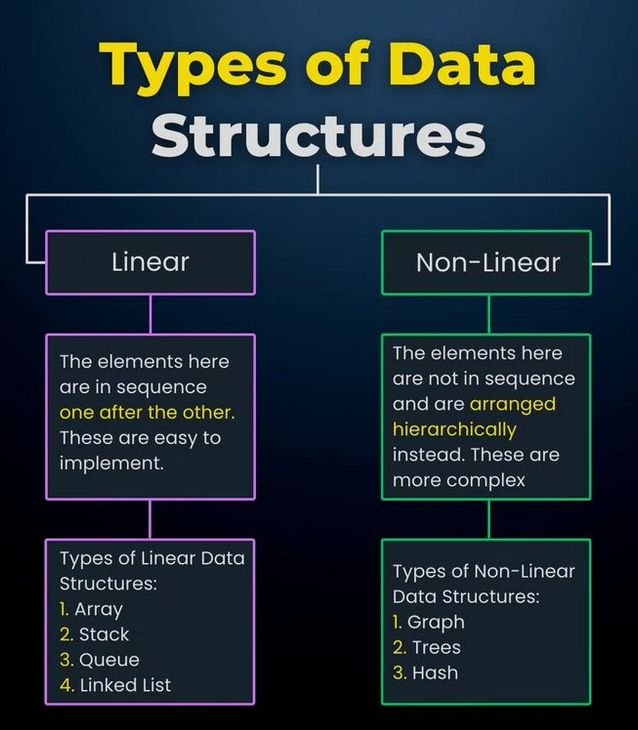
Linear Data Structures
In linear data structures, elements are arranged sequentially — one after another.
Key characteristics:
- Easy to implement
- Memory arranged in a sequence
- Each element has a unique predecessor and successor (except first and last)
Types of Linear Data Structures:
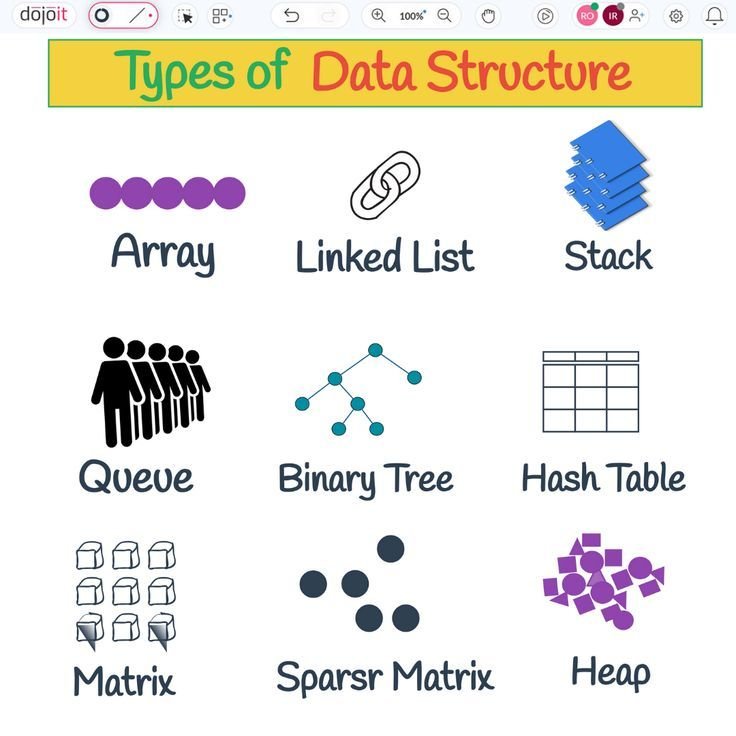
- Array
- Linked List
- Stack
- Queue
Array
An array stores elements in contiguous memory locations.
Features:
- Fixed size
- Fast access using index
- Efficient for storing similar data types
Use cases:
- Storing marks of students
- Handling static datasets
- Implementing matrices
Linked List
A linked list consists of nodes where each node contains:
- Data
- A reference (pointer) to the next node
Advantages:
- Dynamic size
- Efficient insertion and deletion
Unlike arrays, linked lists do not require contiguous memory.
Stack
A stack follows the LIFO principle (Last In, First Out).
Operations:
- Push (insert element)
- Pop (remove element)
- Peek (view top element)
Common uses:
- Undo/redo operations
- Expression evaluation
- Function call management
Queue
A queue follows the FIFO principle (First In, First Out).
Operations:
- Enqueue (add element)
- Dequeue (remove element)
Applications:
- Task scheduling
- Print queue management
- Breadth-first search (BFS)
Non-Linear Data Structures
In non-linear data structures, elements are not stored sequentially. Instead, they are arranged hierarchically or interconnected.
Characteristics:
- More complex structure
- Efficient for hierarchical data
- Used in advanced algorithms
Types of Non-Linear Data Structures:
- Tree
- Graph
- Hash Table
- Heap
Tree
A tree is a hierarchical data structure consisting of nodes connected by edges.
Special type: Binary Tree
Features:
- Root node
- Parent-child relationship
- No cycles
Applications:
- File systems
- Database indexing
- Expression parsing
Graph
A graph consists of:
- Vertices (nodes)
- Edges (connections)
Graphs can be:
- Directed
- Undirected
- Weighted
- Unweighted
Used in:
- Social networks
- Google Maps navigation
- Network routing
Hash Table
A hash table stores data using key-value pairs.
Key advantages:
- Very fast lookup
- Efficient searching
- Constant-time complexity (average case)
Widely used in:
- Databases
- Caching systems
- Authentication systems
Heap
A heap is a special tree-based structure used to maintain priority.
Types:
- Min Heap
- Max Heap
Applications:
- Priority queues
- Scheduling algorithms
- Heap sort
Matrix and Sparse Matrix
Matrix:
- Two-dimensional array
- Used in mathematics and graphics
Sparse Matrix:
- Matrix with mostly zero values
- Optimized storage technique
- Saves memory space
Common in:
- Scientific computing
- Machine learning
- Graph algorithms
Static vs Dynamic Data Structures
Static Data Structures:
- Fixed size
- Example: Array
Dynamic Data Structures:
- Size can grow or shrink
- Examples: Linked List, Stack, Queue
Dynamic structures are more flexible for real-world applications.
Why Data Structures Are Important
Data structures improve:
- Code efficiency
- Performance optimization
- Problem-solving ability
- Algorithm design
Additionally, they are heavily tested in technical interviews and competitive programming.